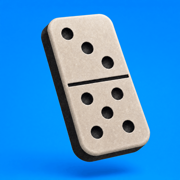
Blank dominoes rules explained
Under standard blank dominoes rules, a blank half means zero. It matches another blank, contributes no pips to a hand total, and is not wild. Named games may give double-blank a special role or penalty, but that exception does not change every blank into any number.
Blank dominoes rules in matching games
A domino with one blank and one six is the 0–6. It can attach its blank half to an open blank or its six half to an open six. After the blank half is covered, the six becomes the exposed end; after the six is covered, the blank becomes exposed.
A 0–6 cannot ordinarily match an open three. Wild blanks exist only in a ruleset or house variant that declares them. Calling blank “zero” avoids the common mistaken analogy with a blank Scrabble tile or a playing-card joker.
The beginner dominoes guide applies this matching rule to Block and Draw.
What are blank dominoes worth?
For remaining-hand scoring, add both ends. A blank–six is six pips, blank–two is two, and double-blank is zero. Blanks do not cancel the value on the other half.
In Block or Draw, someone who goes out may score the pips left in opponents’ hands under a common system. If an opponent holds 0–6 and 0–2, that hand contributes eight. Exact, rounded, and difference-based awards remain ruleset choices.
In open-end games, an exposed blank contributes zero to the end total. It may still help create a multiple: if the other active end is ten and a blank is exposed, the total remains ten and can score in All Fives.
How double-blank works
Double-blank is 0–0. In ordinary matching, both halves belong to the blank suit, and it attaches to an open blank. It is usually laid crosswise like other doubles for visibility.
Crosswise placement does not automatically make it a spinner. In basic Block and Draw, it remains part of the two-ended chain. In an All Fives ruleset that designates a double as a spinner, double-blank can branch if it is the qualifying double.
Double-blank has no raw pip value. That can make it useful to retain under pure pip scoring, but it can also be difficult to play if blank ends disappear.
Blanks in All Fives
All Fives scores multiples of five on active open ends. A blank counts as zero in that arithmetic. If exposed ends are blank and five, the total is five. If they are blank and six, the total is six.
An exposed double-blank contributes zero whether counted by one half or both, so it does not by itself raise an end total. Its spinner status, if any, can open more arms and change which other ends count.
Muggins and Five-Up rulebooks differ about spinners and missed-score claims, but they do not generally turn every blank into a wild match.
Blanks in Mexican Train
Mexican Train normally includes a blank round at the end of a descending game. The blank–blank is the engine, and each train begins with a tile containing a blank. Later blank ends match blank ends normally.
Penalty treatment is edition-specific. Literal pip counting makes double-blank zero, but many published or house versions assign it 25 or 50 penalty points. Some groups also give other doubles special values. Record the rule before the match; otherwise the final round can produce the largest disagreement.
Blank is still not wild in these versions. A special penalty value affects scoring, not legal matching.
Blanks in Chicken Foot
Chicken Foot also commonly descends to a blank–blank round. When double-blank is played as an ordinary double, the three tiles needed to complete its foot must contain blanks.
As in Mexican Train, many editions assign double-blank a special leftover penalty. An unfinished blank foot and a last-tile double can also have edition-specific treatment. Use the selected Chicken Foot rules rather than importing a train-game value.
Domino Scoreboard is a score keeper for real tabletop games covering five modes: Block, Draw, All Fives, Mexican Train, and Chicken Foot.
Why blanks are easy to misplay
Printed dots look like numbers, while an empty square can look like missing information. In a standard numbered set, however, the absence of pips is deliberately the zero member of the sequence.
Color coding does not change this. Some sets give each number a color, some color each half independently, and some use black pips throughout. Legal matching follows pip value, not the plastic color or background.
When teaching, say “zero” for the first few turns. Arrange 0–0, 0–1, 0–2, and onward together to show that blanks form a complete suit.
Declaring a wild-blank house rule
A group may invent a version where blanks match any number, but it changes tile connectivity and blocking. Define whether a wild blank takes on the matched value permanently, whether its other blank remains wild, and how double-blank behaves.
Keep that variant separate from standard scoring instructions. A score sheet should label it “wild blanks” so players do not assume normal zero matching.
FAQ
Are blank dominoes wild?
No, not in standard numerical matching games. A blank represents zero and matches another blank unless a declared variant makes it wild.
How many points is a blank domino?
The blank half adds zero; the other half keeps its value. Blank–six is worth six pips, while double-blank is zero by raw pip count.
Can you play double-blank on any number?
Normally no. It plays on an open blank. A named wild-blank variant may change that rule.
Why is double-blank sometimes worth 50?
A published double-nine Chicken Foot ruleset assigns 50 points to a retained double-blank; Mexican Train and other Chicken Foot editions may use zero, 25, 50, or another declared value. That is a scoring convention, not its pip value and not a universal rule.
Free Domino tools
- Domino Set CalculatorCompare common domino set sizes and check how many tiles and doubles each set contains.
- Domino Starting Hand CalculatorSet up Block, Draw or Mexican Train without arguing over how many dominoes each player gets.
- Mexican Train Score SheetEnter two to eight names and round scores. The lowest running total is highlighted automatically.